Sunday, September 22, 2013

Genesis 32-33, 35 - God Wrestles with Jacob

Here's the first time that I don't necessarily agree with The Story's choices of stories... Because we dive right into a new story of Jacob and Esau without the necessary background (well, background is given, but it's in a transition part of the chapter).

So, here's the quick background. Isaac had two sons: Jacob and Esau. Even though God had told Rebekah and Isaac that "one will be stronger than the other; the older will serve the younger" (Genesis 25:23), Isaac still preferred Esau over Jacob and was ready to give the birthright to him. As Isaac's health was failing and he was ready to bestow the official birthright, Jacob deceived his father by dressing up in animal skins to give the appearance of the hairy skin that Esau had, thereby tricking Isaac into bestowing the official birthright on him instead of Esau (Genesis 27). Now even though Esau had previously despised the birthright (Genesis 25:19-34), he was mightily ticked off and vowed to kill his brother should they meet again after Jacob fled (Genesis 27:41-45). And now we pick it up at where Esau and Jacob are about to meet again for the first time in a few decades.

God is about to test Jacob.

My previous post discussed what I think it means to be tested by God, and while that particular word is not used in this passage, I would argue that it was indeed a test from God to strengthen Jacob and form him into Israel.

Unfortunately, what The Story leaves out in this build-up to this moment is the fact that for most of his life, Jacob has taken the easy way out. Instead of hunting for food and providing for the family like Esau did, Jacob took what was provided and refined it into soup. Instead of talking one-on-one with his brother about the birthright and God's promise, Jacob used his brother's hunger against him and was able to get Esau to despise his birthright. Instead of talking to his father one-on-one, Jacob deceived Isaac into thinking that it was he was Esau and was ready to receive the birthright instead. And instead of owning up to what he did and standing before his brother to talk about the situation, he ran away so he wouldn't have to face Esau. Jacob definitely lived up to his moniker of 'deceiver.'

Interestingly enough, he begins to see the errors of his ways while in hiding as he himself is tricked into marrying someone (Leah) he doesn't want to. However, Jacob does not settle and continues to work for 7 more years to marry the true apple of his eye, Rachel. Not only that, Jacob even continues to work for this Laban fellow until there are rumblings that Laban is not happy and thinks that Jacob's out to get him.

Jacob's life has gotten tougher (especially now that he has kids and a job to worry about...), but it's nothing compared with the prospect of returning back to his homeland and an upcoming encounter with Esau who was last seen completely ready to kill Jacob. All of a sudden, life kinda comes into perspective, does it not?

And notice that it's at this point that God wrestles with Jacob (notice that Jacob doesn't initiate the match; it's God who does (Genesis 32:24)). Can you imagine what it would feel like to physically wrestle with God? We asked that question in our youth classes today and pretty much every kid said to a tee, "I would be scared because he could kill me in an instant."

Yet, it's pretty evident that in our lives, we struggle and strive with God quite a bit. Have you been struggling with a sickness or health issues? That's wrestling with God. How about family frustrations or financial fiascos? That's wrestling with God. What about all the injustices in the world we read and hear about? That's wrestling with God too. Now while God doesn't cause these things (the devil does through this little thing we call 'sin'), he uses them to make us stronger... to train us... to purify and refine us... to make us realize that the easy way is not always the best way.

And in the end, through these tests and through these struggles, God gives us power to overcome adversity, just as Jacob did (Genesis 32:28).

I think Paul says it best that in all of this adversity (and he went through plenty!!), we can "do all this through him [Christ] who gives [us] strength" (Philippians 4:13).

Other questions to think about (and that I didn't have time or space to write about):
- Do you think there was any symbolism about God dislocating Jacob's hip versus some other part of the body?

- And not so much of a question as it is just another resource; I totally dug this sermon I found online. Definitely worth a read!

Friday, September 20, 2013

Genesis 21-22 - Abraham Tested by God

Let me be honest and up-front: I hate this story of Abraham and Isaac. While some people hold it up as a paragon of virtue because Abraham was ultimately faithful in the face of some pretty gruesome consequences; I hate it because what kind of god would ask for human sacrifices?

Why would God 'test' Abraham this way?

As I read through this story a year ago or so; I compared this situation to a parent who uses Love & Logic. In Love & Logic, you give kids choices and hope that they fail when they're young so that they learn their lessons when consequences are much smaller and less dire. I compared Abraham to the kid and God as the father. Abraham kept making mistakes (Egypt and Pharaoh, Hagar and Ishmael, disbelief in God's promise of a son...), but God kept giving him a second chance. Eventually, Abraham got to a place in his walk with God that he was able to pass the ultimate test of faith and be blessed for it (Genesis 22:15-18). I still don't like the idea of a loving God waiting for me fail and pass a test; but it at least added some logic to it.

Why does God test? Or, perhaps a more useful question: What is a test from God?

I think that we as humans, and ones who are living in an educational society where we face 'tests' all the time, have a different view of this test than God does. We view tests as something to pass and fail. If we pass, we're blessed with a good grade; if we fail, we're cursed with extra-curriculars being suspended, detention, or tension at home.

When we 'test God,' it is in this black and white way of seeing things in which it happens. Let's look at a few verses in which humans test (nâsâh) God:

"He named the place Massah and Meribah because of the quarrel of the sons of Israel, and because they tested the LORD, saying, 'Is the LORD among us, or not?'" (Exodus 17:7).

"You shall not put the LORD your God to the test, as you tested Him at Massah" (Deuteronomy 6:16).

"And in their heart they put God to the test by asking food according to their desire" (Psalm 78:18).

In each case, there is a pass or fail aspect to the test - either God is here and will provide for us, or he is not and we're being left to fend for ourselves. This is the kind of test that we're used to here on earth.

Yet, when we read about testing (nâsâh) from God, there is no pass/fail aspect to this test at all. Hopefully you'll be able to notice that in the following times that nâsâh is used:

"Moses said to the people, 'Do not be afraid; for God has come in order to test you, and in order that the fear of Him may remain with you, so that you may not sin'" (Exodus 20:20).

"In the wilderness He fed you manna which your fathers did not know, that He might humble you and that He might test you, to do good for you in the end" (Deuteronomy 8:16).

"Examine me, O LORD, and try me; test my mind and my heart" (Psalm 26:2).

It seems to me that when God tests, it's not a pass/fail test, which is very good for us because chances are we would fail anyhow! When God tests (nâsâh) us; it's a design that is utilized to bring about nothing but good in us. There is no failure; only formation. There is no resigning, only refining. There is no breaking, only building.

So when God 'tested' Abraham, it was not a test from a sadistic god thirsty for blood from an innocent child. It was a pre-arranged process to bring forth good from Abraham, the father of nations - an interesting and frightening process for sure - but still a process.

One can only wonder what tests God has prepared for us in advance to participate in; but when they do come along, take heart because through our Savior, Jesus Christ, we have already overcome the entire world (1 John 5:3-5) and if God is for us in these tests, who can be against us (Romans 8:31)? For "we know that in all things God works for the good of those who love him, who have been called according to his purpose" (Romans 8:38).

Other questions to think about (and that I didn't have time or space to write about):
- Anyone else notice any similarities between Ishmael's story and Moses' story? (Being left for dead... growing into a strong leader of nations...)

- Also, did anyone notice the similarities between Abraham and Isaac's story and Christ's story? (The son who the covenant is continued through... the third day... a lamb/ram was provided for the sacrifice...)

Thursday, September 19, 2013

Genesis 15-18:15 - God's Covenant with Abraham

What's in a name? Why are our names important; or maybe today in our culture, why are our nicknames important?

Well, speaking from childhood experience, our names and nicknames mean that people love us and want to know us other than "hey you!" For instance, one of my best friends has a nickname for me: Briguy. I have no idea why I like it; but it's his term for me and I always smile when I hear it from him. Likewise, my brother is always known as "Steve" to all of his friends because it took a life on its own and it labelled their relationship with him (though we as his family could ever only call him "Stephen"... kind of annoying since I wanted to be cool like his friends...).

What names or nicknames are you known by?

In the Hebrew culture, a name was more than just a name (did you know I was named Brian just because it sounded good?). A name was a definition of who you are and who you would be. 'Adam' meant 'earth' because he was formed from the earth (Genesis 2:7). 'Eve' meant 'mother of all the living' (Genesis 3:20). 'Isaac' means 'laughter' (Genesis 21:6). And later on, 'Esau' means 'red' (Genesis 25:25) and 'Jacob' means 'deceiver.'

Since Jewish names and destinies are so intertwined, do you see why God changing Abram's name is so incredibly important now? God is not simply changing Abram's name. It's not simply adding an additional 'ha' between the a and the m. God is changing the destiny of Abram. He is changing Abram - 'exalted father' - to Abraham - 'father of many nations' (LSB Study Notes, Genesis 17:5). This was a sign of God's pledge to keep the covenant with Abraham that He had made many years ago. As CPH's People's Bible Commentary says: "If God would fail to keep his covenant promise, the name Abraham would constantly testify against him" (p. 151).

Did Abraham do anything to deserve this covenant? Nope! Let's see... he tried to get away with Pharaoh taking Sarai as one of his wives... he listened to Sarai when she suggested that he try to have a son with her servant... and he laughed when God again reiterated His promise to him (Genesis 17:17).

Likewise, do we do anything to deserve God's new covenant through his son, Jesus Christ? The very thought is laughable! We sin daily in thought, word and deed; by doing things we know are wrong and leaving righteous things undone. Yet, God continues to call us and beckon us through his Holy Spirit; and in doing so, changes our very destiny. We go from sinners to being saints; guilty to righteous; from being condemned to being saved. As John says, "See what great love the Father has lavished on us, that we should be called children of God! And that is what we are!" (1 John 3:1). And it is through this destiny as children of God that we can see again and see who we are meant to be.

Other questions to think about (and that I didn't have time or space to write about):
- Are you catching the beginnings of some family dysfunction here? That's definitely going to be a theme going forward in the next chapters of Genesis (some we'll read, and some we won't).

- Have you ever thought "why circumcision as a sign of the covenant rather than a less... er... invasive sign of the covenant?"

- Ever wonder became of Ishmael? Make sure to ask an Arab or a Muslim :)

Wednesday, September 18, 2013

Genesis 12-13 - God's Call to Abram

I want to start today with the idea of tuning forks. For those of you who don't know what tuning forks are, they are shaped pieces of metal so that when they are struck, they make a vibration that is precisely-pitched. This pitch is then used to tune your instrument such as a piano or violin.

But the tuning fork itself is not what I want to expound upon; it's the idea of resonance. A neat experiment to do is to take two tuning forks of the same pitch; strike one while leaving the other one alone; and the result will be that the tuning fork that was not struck will begin to vibrate on its own because it has picked up the same pitch as its brother.

Abram was attuned to God's voice. God's voice resonated with him and caused him to act.

We often mistakenly lump Abram along with the rest of his family... because Abram was pious, we often make the mistake of thinking the same about his family. But, that's not true. According to Joshua 24:2, Abram came from a line of people who worshiped (actually, I like the Hebrew word here, which means 'served'; it's more participatory and active) other gods.

So can you imagine how hard it would have been for Abram to stay attuned to the true God in and among all the other voices in that household? Yet, Abram was so in-tune with God that all God needed to do was simply say, "Go from your country, your people and your father’s household to the land I will show you." Can you imagine what it would be like to have such a full communion like that with God?

Yet, Abram wasn't perfect. Just as the sound from a tuning fork eventually fades, so our hearing fades when it comes to God's voice speaking to us. Once Abram moved to Canaan, a severe drought and famine arose; and rather than hearing God's voice and trusting what he said, Abram and Sarai moved to Egypt because they figured that they would have a better chance of survival. The plan in and of itself from human terms wasn't necessarily a bad idea; the only problem is that it went against God's plan and so God caused it to fail.

Abram realizes his error and returns back to his sacred place with God - the place where he was attuned to God's voice - Bethel, and again reorients himself back to God's voice.

After this worship, God grants Abram another test as Lot and his family realize they need more space. So, Abram, now re-orienting himself to the life that is God, allows Lot the first pick of the land. As Lot picks the more watered land (which, interestingly enough, is compared to the garden that Adam and Eve where expelled from, and it is the land of Sodom and Gomorrah before they were destroyed...), my guess is that Abram felt somewhat cheated and disheartened.

Yet, it is in this moment in which Abram is disheartened, that again God's voice resonates with Abram as he says, "Look around from where you are, to the north and south, to the east and west. All the land that you see I will give to you and your offspring forever. I will make your offspring like the dust of the earth, so that if anyone could count the dust, then your offspring could be counted. Go, walk through the length and breadth of the land, for I am giving it to you" (Genesis 13:14b-17).

In our troubles, God speaks to us and gives us words of comfort, words of promise, and words of hope. It is my hope and prayer that the Holy Spirit continually works inside of us as a tuner, orienting our ways so that our lives can resonate with God's heavenly sound of life.

Other questions to think about (and that I didn't have time or space to write about):
- Isn't it interesting how God can work? God speaks creation into existence; and God speaks a nation into existence? Doesn't that give a bit more importance to the idea that we should be listening for God to speak to us since his words are formative and can bring life from nothingness?

- Ever wonder what Sarai must have been thinking through their Egyptian sojourn?

Friday, September 13, 2013

Genesis 9 - God's Covenant with Noah

As we close our first week in The Story (I hope you've enjoyed it, by the way!), we come to one of the classic stories in all of Christendom: the covenant with Noah where we hear of a rainbow for the first time (now I'm not saying it was the first rainbow, but that's another journal post in and of itself). It's a story that gives us a warm feeling inside because a) a rainbow is one of the most beautiful creations of God, and b) we hear that God loves us, so much so, that he has promised to never again destroy the world.

But why a rainbow?

First of all, they're relatively rare. Rainbows need rain, and we don't receive rain every day (and after July or so this summer, we've hardly seen a drop of it). Rainbows need sun, and not every precipitation event comes with sun; in fact, many times it's just overcast throughout the whole event. Third, the angles have to be quite precise. Did you know that to see a rainbow in the sky, the sun's rays have to form an angle with your line of sight that can be no less than 40 and no more than 42 degrees? For most of us here on earth, that only happens twice a day (though if you have a mist or spray, such as one that comes from a waterfall, you can easily manipulate your line of sight to create the needed angle).

These signs of God's promise are not common enough for us to disregard because we've grown accustomed to them; but they aren't rare enough that it's a once-in-a-lifetime occurrence either. We see just enough of them to consider them special and to keep fresh in our minds God's special promise.

Second, what two things do we need to create a rainbow again? Indeed, sunlight and water. I do suppose that the first thing worth mentioning here is what were two of the first things that were created? The formless, swirling deep; and light (which, incidentally is why I don't think Noah's is the first rainbow, because there was plenty of light and water well before Noah's time...).

But, taking this a step further; who does Jesus say he is? Well, he says he is living water (John 7:38) and also the light of the world (John 8:12). Now whether God the Father gave this as a foreshadowing or not, I don't know. Yet, it's neat to see that in the symbol of God's promise we see beauty, splendor and majesty; just as we see the beauty, splendor and majesty of God's love for us in his son, Jesus Christ.

Finally, when do we see the rainbows? When do most storms usually happen (at least around here)? Usually after a long day of diurnal heating and the air becoming more saturated with humidity and water vapor. In other words, most storms here happen in the evening hours. The storm hits with its ferocity and passes thereafter; and that's when we see the rainbow. We see the rainbow as the sun is setting and getting ready to rise again because the storm has passed and we are still here.

So, why a rainbow? It's not a sign that God never will destroy the earth again; it's a sign that God already has kept that promise, because the storm has passed and a new day is dawning.

Other questions to think about (and that I didn't have time or space to write about):
- So if God now gives mankind permission to eat animals; what is the purpose of Abel keeping flocks as a shepherd if not for food?

- Has anyone else noticed that the flood seems to be another creation narrative? The waters receded by a wind sent forth by God (Genesis 8:1), much like the Spirit hovering over the face of the deep (Genesis 1:2)? And now you have the same blessing from God to "be fruitful in number and fill the earth" (Genesis 9:1) as did Adam and Eve (Genesis 1:28)?

Thursday, September 12, 2013

Genesis 6-8 - The Flood

Are you ready for a little exegetical study today? Well, neither was I, until just out of curiosity I looked up a few words and was kind of blown away!

In prepping for today's entry, I noted that there were 2 bookends to this story:

"The Lord saw how great the wickedness of the human race had become on the earth, and that every inclination of the thoughts of the human heart was only evil all the time" (Genesis 6:5).

"The Lord smelled the pleasing aroma and said in his heart: 'Never again will I curse the ground because of humans, even though every inclination of the human heart is evil from childhood...'" (Genesis 8:21).

Now, as good Lutherans, we have this idea fully ingrained into our psyche and theology. We begin each service of our Divine Liturgy with confessing that we are "by nature, sinful and unclean." We are fully aware of the doctrine of original sin and the impact it has on us. (Though as quick side note: not all versions include the word 'every' before 'inclination', which I find interesting in itself because the theology that follows from excluding that one word could be quite different...)

But after my research, I have a deeper understanding despair of what original sin is.

I started off by wondering what exactly the word 'inclination' means. To begin with, when I used the interlinear Bible, the King James Version actually uses the word imagination. Already, my mind was starting to spin because to have an imagination is to participate in the sheer act of developing a coherent thought... it's the process. So what God is saying that even the process of forming our thoughts of the heart is evil. Would you not say that this is stronger than just an 'inclination', or a 'thought' being evil?

Digging further, the word comes from the Hebrew word yêtser, which means 'to form' and is used in one of Isaiah's illustrations that God is the potter and we are the clay. Adding this into our equation, we end up finding that not only is the process of our thinking evil from birth; but that we value these thoughts. We think they are valuable, like the potter does his clay. Stronger language yet, wouldn't you say?

And for one final layer, yêtser is derived from the other word yâtsar, which means basically the same thing; but notice five times (out of around 50) where it is used:

"Then the Lord God formed a man from the dust of the ground and breathed into his nostrils the breath of life, and the man became a living being" (Genesis 2:7).

"Now the Lord God had formed out of the ground all the wild animals and all the birds in the sky..." (Genesis 2:19).

"The sea is his, for he made it, and his hands formed the dry land" (Psalm 95:5).

"But now, thus says the LORD, your Creator, O Jacob, And He who formed you, O Israel, 'Do not fear, for I have redeemed you; I have called you by name; you are Mine!'" (Isaiah 43:1).

"Yet you, Lord, are our Father. We are the clay, you are the potter; we are all the work of your hand" (Isaiah 64:8).

Wow. So in our bookends of the reading today, God lets us know what our way should be. We should want to follow our Creator and hold him and his ways dear to our heart. God wants us to choose his ways to bring us life.

Instead, we hold steadfast to our own ways, and even let them become near and dear to us, because we believe that they will bring us life. Unfortunately, as we saw yesterday, those ways only bring us death.

But thankfully, as God promised to never again destroy the earth (Genesis 8:21-22), so he has promised that through his son, we will always have life (oh, let's go John 3:16 here :)).

Other questions to think about (and that I didn't have time or space to write about):
- If they stayed in the boat for over a year; and we always assume the animals took the space; where did they put food to last them and the animals for that whole time? (Are there any artists' depictions of that?)

- Is there something significant to a dove being used by Noah (connection to baptism?); or do you think he used them for their superior homing abilities?

- For further research, what are the similarities between this flood account and many other accounts out there? (One notable one I found was in the fate of our protagonist, compared to the fate of those in other Middle Eastern accounts...)

Wednesday, September 11, 2013

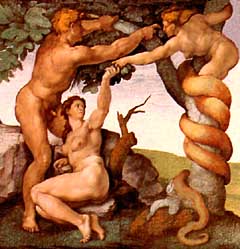
Genesis 3 - The Fall

I'm going to talk about Satan, the Accuser, the Deceiver, the Father of Lies, the Evil One, the Ruler of Darkness, and any other name you can think of. But I'm not going to talk about him in the way you probably think I'm going to talk about him. Are you ready?

In this chapter, he told the truth. A half-truth to be sure, but he still told the truth.

Did I catch you by surprise? Don't believe me? Well, check it out:

"'You will not certainly die,' the serpent said to the woman" (Genesis 3:4).

And did they die? Not that instant. So, you can't fault him for being truthful there. Again, it's a half-truth, because they did die later as a result, but he still told the truth.

"For God knows that when you eat from it your eyes will be opened, and you will be like God, knowing good and evil" (Genesis 3:5).

Did Adam and Eve know good from evil from that point, they sure did as they immediately hid when God came to have a vineside chat with them. In fact, this statement was probably more truthful than his previous statement. Did he tell the whole truth? No, but indeed, what he did say came to pass.

And this, my friends, is what makes the devil so dangerous. His statements will always have truth to them. He and his cronies say all sorts of things to us today that have truth to them, but they say them in such a way as to hide the disastrous underbelly to those truths. Ultimately, they speak words that we think bring us life; but following those ways ultimately brings death.

"Having lots of money will bring you happiness," the devil says and it seems true. Only, he leaves out the part that the pursuit of it will leave you emptier when you started because you'll never have enough.

"To be secure, keep constant vigilance," the devil says and it seems true. He only leaves out the part that keeping constant vigilance requires more and more of your energy and your life, leaving you ever more insecure and afraid.

"As long as you don't hurt anyone else, do whatever feels right and good," the devil says and it seems true. Only, he leaves out the part that as you focus more and more on yourself, you alienate yourself with the community. Then when you really do need help, no one is there.

All in all, Satan is completely correct in the fact that we will never be secure; and he made that point abundantly clear to Adam and Eve. He is right in the fact that the only way we will ever be totally, 100% secure is if we're like God. He is truthful when he says that we can only be secure when we have it all.

But what he leaves out is that God has given us enough. He leaves out the fact that God gives us enough. He leaves out the fact that God will give us enough. He leaves out the fact that all of these pursuits of security lead us away from God. He leaves out the fact that when we follow our own way instead of God's, it leads to death.

Thankfully, even as God makes sure that Adam and Eve cannot eat of the Tree of Life, and makes the consequences of their actions known to them, he gives a promise:

"I will put enmity between you and the woman, and between your offspring and hers; he will crush your head..." (Genesis 3:15).

In this promise, God foreshadows that He will again give us enough; actually more than enough; more than we could ever need - His Son, Jesus Christ. And though Satan struck at his heel, Jesus will crush him once and for all. Can't wait!

Other questions to think about (and that I didn't have time or space to write about):
- Ever wonder what it must've been like to be able to talk to God face-to-face in the garden?

- Have you ever noticed that God warned "you shall die..." but that is the last part of the enumeration of the consequences? Wouldn't one think it'd be the first? (and the fact that he didn't use the actual word, 'die'?)

- And was it a blessing or a curse that they could not re-enter the garden once God closed the doors?